Author: Howard

  • You Need a Plan

    You Need a Plan

    coins-balance
    Image credit: Pixabay

    Even you’re scraping by on a minimum-wage job, you need a budget.

    The basic plan is pretty straightforward:

    1. Total your income from all sources
    2. Estimate you total expenses
    3. Calculate the difference

    If the difference is negative, you need to figure out how to fix that! You can either increase your income, or decrease the outgo, or both. The easiest way is usually to decrease your outgo.

    If you have been caught up in the credit card trap, the first step is to cut all of them up. Contact the credit card issuers, and let them know that you are in trouble, and you will not be be charging anything for a while, and tell them that you need for them to cut off your credit supply. You may be able to arrange some relief from your credit card company — especially if the alternative is your bankruptcy, in which case, they don’t get anything. Then, if you can’t afford to pay cash, don’t buy it.

    LivingMinimumWageIf you smoke – stop. That can save you over $100/week! That’s one of the most expensive gratuitous habits you can have. Except maybe for illegal drugs.

    Groceries? One thing I learned in my early years was that preparing my lunch and taking it to work every day was equivalent to a $200/month tax-free raise. That was a long time ago, so it’s closer to $500/month now. When you go to the grocery store, use a list, and stick with it. And remember: If it comes in a box or a bag, it’s probably overpriced.

    If you don’t know how to cook, learn! It’s not hard, and the only things you really need are a pot, a good knife, a big spoon, and a source of heat. More equipment is nice, but I know from my own personal experience that you can prepare adequately nutritious meals with only those utensils. And you can get all of those at a thrift store for not much more than the price of a Big Mac.

    Clothes? Back when I was in college, and was working in the cafeteria to get by, I found that I could still dress OK even for special occasions by buying all of my clothing (except underwear) in thrift stores. I once bought a really nice double-breasted suit for $7.50. Even in the mid-seventies, that was a pretty good deal. I was wearing that suit when I met the girl I later married.

    Transportation? If you live in an area with bus service, you will find that is the cheapest way to get around. Well, maybe walking is cheaper. And you can probably find a serviceable bicycle for less than the cost of a tank of gas.

    Housing? That can be a problem, but you can reduce expenses by getting a roommate. If the price of housing is just way too much, consider moving to an area with cheaper housing.

    I’ve been through times where I had to make the decision of whether to eat or pay the rent and buy transportation to get to work for a week while waiting on my first paycheck. As it turned out, fasting for a week didn’t do me any harm.

    Most of the readers of this are not in such dire circumstances, so trimming expenses will not be as difficult. But I have personally lived through all of the above (I didn’t smoke or do dope, which made things much easier!), so I know it can be done.

  • Want to Cruise? Avoid These Money Traps!

    Want to Cruise? Avoid These Money Traps!

    YourFirstCruiseCruising can be one of the most economical modes of vacationing, considering what you get for your cruise fee, namely, a floating luxury hotel that travels to several ports. All of the meals are included (well, sort of… see below), and you only have to unpack and re-pack once. Many of the amenities are no extra charge.

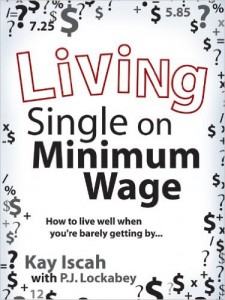
    Cruising has been one of the favorite activities that my wife and I have done for the last several years. My wife likes it even more than I do — she wrote the book that you see pictured in the upper left of this article. Oh, yes, that’s me in the green shirt.

    However, there are still a lot of money-sucking traps waiting for cruisers. Some of them are blatant rip-offs, but there are a few that you just need to plan for to minimize the impact on what should be a stress-free week (or longer) of shipboard relaxation.

    Double-Occupancy

    For starters, be aware that all cruise prices are quoted as “per person” but almost always assume double occupancy. So when you see a $800 cruise, just mentally double that, because you will probably pay $1600 for that cruise, even if you are traveling by yourself.

    There are a few cruise lines that are beginning to cater to single travelers with smaller cabins set up for just one occupant, but those are the exception. Sometimes, the cruise line will connect you up with another cruiser to share a cabin, but rooming with a total stranger for the duration of the cruise might not be something you want to do.

    Snack, Sodas, and Juices

    Things like ice cream and sodas (outside of meal times) also generally cost extra. There are a couple of ways to reduce the cost of these items. The way I do that is simply not eating outside of the dining room at mealtime, but one of the attractions of cruising for most folks seems to be non-stop eating.

    Some cruise lines offer beverage packages that include generous (sometimes even unlimited) quantities of soda and premium juices. The price on the beverage packages may seem high, but if you are going to drink lots of carbonated beverages or fruit juice, they will save you some money.

    Alcoholic Beverages

    While many of the amenities are no extra charge, there are some that cost a lot extra. If you are fond of alcoholic beverages, you can easily rack up a drink bill that exceeds the cruise fee. And the cruise line will not allow you to bring your own, since that’s a major source of income for them. Occasionally, there will be activities that feature free drinks, but those are a bit rare. Personally, I generally choose not to drink on board. Even the drinks in the tourist traps are cheaper.

    There are sometimes beverage packages that include alcoholic drinks. I’ve never tried any of them, since I wouldn’t drink enough to make them worthwhile to me.

    Premium Dining

    A trend that I find a bit disturbing is the “premium dining” venues. So far, I have not tried any of them to see if they are worth the extra $20-$50 per person, but I have recently noticed that there are some extra-cost items on the menu in the regular dining rooms. I suspect that the cruise lines are trying to move to more extra-cost dining, and I think that they would probably like to get rid of the “free” dining business model completely.

    Probably the only reason they have not already done so is that a large percentage of cruisers (including me) would start opting for other types of vacations.

    Souvenirs

    The trinkets and souvenirs available on a cruise are grossly overpriced. In fact, just about any item in a shipboard shop is going to cost you about 3-4 times the cost of that same item almost anywhere else. There are a few exceptions, but not many. Plus if you look carefully, you will see that most of the souvenirs, even in the tourist traps in the various ports, are made in China.

    What I have typically done for souvenirs is to wander beyond the tourist trap, and just get a couple of dollars’ worth of the local currency, usually in coins. Ok, I have to admit that I’m guilty of buying a few overpriced T-shirts and hats, too, but I budget for those items before I go.

    Excursions

    I generally don’t go on many excursions, but I have enjoyed a few. Be aware that the excursions that you can book on board will cost more than those you can arrange for yourself. However, even though they are more expensive, I recommend that you get the cruise-sponsored excursions, for one very important reason: If a cruise-sponsored excursion is delayed getting back for any reason, the cruise line is responsible for getting you back on the ship. Otherwise, you are on your own. Believe me, you don’t want to get left behind.

    Sponsored Tourist-Trap Shopping

    One money-trap I have avoided completely is the “recommended shopping” venues. Most cruise lines will have on-board sessions (“lectures”) on things to buy in the next port of call. I have never found any of those to be worthwhile. You just aren’t going to find any of those specialty items cheaper in a port of call than you can get either at local shops at home, or on the Internet. Oh, and speaking of Internet…

    Slow and Unreliable Shipboard Internet

    If you can possibly get completely away from accessing the Internet while you are cruising, do that! A week of shipboard Internet will cost you more than 3 months of your home broadband service, and the performance will be much slower. Painfully slower! Unfortunately, Internet is something that my wife and I don’t want to do without for a whole week, so what we do is get one “unlimited” account and share it.

    Here’s a big hint: Do your websurfing or email access very early in the morning, while most of the other cruisers are still asleep. I have found that I can get more Internet stuff done between about 5 a.m. and 7 a.m. than I can in the other 22 hours of the day combined. Occasionally, you can find an Internet cafe in a port, where you will find reliable broadband for about 5% or less of the cost aboard ship. However, you might not really want to spend your port time that way, and the Internet cafes are never in the tourist-trap areas, so you will have to do some traveling beyond those areas.

    Shipboard Casinos

    I consider it a great blessing that gambling never had much appeal to me. I try to avoid the shipboard casinos completely because they always stink like ashtrays. But even if the second-hand smoke doesn’t bother you, note that the payouts on the shipboard casinos are lower than you will find just about anywhere else in the world. A lot lower.

    Paparazzi

    Another item I would like to mention is the shipboard photographers. I have noticed that starting about two years ago, the “official” photographers suddenly got a lot less pushy. I suspect that there were some high-profile complaints about that. Needless to say, the photos available aboard your cruise are grossly overpriced, and you can probably get photos you would like better using your cellphone. I have even gotten our dinner waiters to take photos of my wife and me with my cellphone.

    Speaking of cellphones…

    International Cellphone Roaming

    Unless you are willing to go through the hassle of getting an international SIM, just put your cellphone on “airplane” mode for the whole trip. Otherwise, you can come back to a really nasty surprise in your cellphone bill for international roaming.

    I just accept the fact that I’m not going to be making or receiving any phone calls at all while I’m cruising, and I actually like it that way.

    Tipping

    One last item: Tipping. Always tip generously. Especially if one of the service staff goes out of his/her way to help you or fill a special request. Most of the crew that work their tails off to make your cruise enjoyable and trouble-free are not paid very well. Set aside a couple hundred dollars to use for tips at the end of the cruise. Just do it. While it’s an extra expense, I don’t consider this to be a money “trap.”


  • Shaving on the Cheap

    Shaving on the Cheap

    I keep running across various ways to save “lots” of money on the ritual of shaving. That sort of post seems to have a very broad appeal, since almost everybody shaves. Most women shave their legs, and most men shave their faces. I wear a beard, but I still shave in order to keep the appearance neat.

    A few months ago, I saw a blog post on Thousandaire about reducing the cost of shaving your face to a couple of bucks/month. It was mostly about an outfit called The Dollar Shave club. I wasn’t terribly impressed, since I already spend a lot less than a dollar a month on razors. I’ve also found that razors tend to dull more from corrosion than from cutting whiskers, so I carefully dry my blades after each use, and the el cheapo blades I get in bulk at the discount stores (15 or so for about $10 — but NOT this brand!) usually last me about a month each before I notice any discomfort.

    This morning, in Gary North’s newsletter, he talked about a couple of ways to extend the life of a shaving blade to 3 months or longer. (I don’t have a paid membership, but his free newsletter is usually work reading.)

    Here is one way from a video on YouTube, in which the video creator says that he gets at least 6 months of use out of his razors:

    Dr. North considers that the “time consuming way”. He took that a bit farther by putting up a strip of blue jean material on his towel bar and using that as a strop. He reports getting 3 months use from one blade.

    But he also tells about another method he has tried (the “non-time-consuming way”), which extends the life of the blade by several more months. He has a glass of cheap olive oil in which he leaves his razor to soak between shaves. Since the real enemy of the sharp edge is corrosion, this is probably one of the better ways to keep your blade sharp. I suspect almost any oil would work (although most vegetable oils will go rancid in a few weeks). I may try an ounce of synthetic motor oil (since I happen to have a partial bottle of the stuff in the garage) to see if that works.

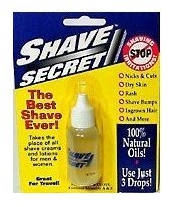
    I think that one of the reasons that my blades last as long as they do is because I don’t use shaving cream. Instead, I use Shave Secret, which is a blend of oils.  So, when I rinse the blade in hot water, tap all the oily whisker residue out, and wipe it dry, there is probably a very thin film of oil left. Shave Secret comes in a tiny plastic bottle, which lasts me about 6-8 months, since you only need 2 or 3 drops per shave.

    Mrs. BFTROU does me one better. She just uses coconut oil, which also works quite well.

  • New Theme

    New Theme

    When Mrs. BFTROU set up this blog, she chose the Atahualpa theme, mainly to experiment with it. One of our friends uses Atahualpa, so we figured it would be a good theme to use.

    Today, I got rid of it, and replaced it with a much simpler but less customizeable theme. Not so much because I didn’t like the theme, but because I just didn’t have the time or inclination to deal with the literally thousands of different customizations available with that theme. Plus the last batch of customizations made the site difficult to read.

    Atahualpa is probably GREAT for somebody who either has only one blog, or wants to use only Atahualpa on all his/her blogs. Otherwise, the sheer complexity of the theme will drive you nuts.

    For me, a less complex theme gives me most of what I want. I hope that the result is easier to read and navigate. Bear in mind that this is probably not the last time I will update the theme…

    If you have any suggestions for improvement in any aspect of this site, please feel free to comment below — or use the contact form if you don’t want to excoriate me publicly.

  • A Credit Report That is Really Free!

    A Credit Report That is Really Free!

    Usually, when you get a “free” credit report, you have to enter a credit card. Then, if you forget to cancel your “service” you get billed after the “free” month.

    However, there is a credit reporting service that doesn’t do that. It is really free. They are hoping that you like the service enough to continue to use it – and they appear to have lots of happy “customers.”

    One minor glitch, however — it isn’t really your “offical” FICO score. They arrive at their figure a different way, and it’s an estimate. However, it’s pretty close, and their score will tell you things like whether your real FICO score is going to be in the ballpark for qualifying for a decent rate on a mortgage. And unlike a real credit check, it won’t affect your credit rating at all (they do what is called a “soft inquiry”).

    As an added bonus (it’s all free, mind you), you can use their “what if” simulator to see how much impact certain transactions might have on your real FICO score.

    The downside? Well, they get your email address, and you get on an email list (surely you anticipate this sort of thing these days!). Then, when you use their site, you get shown ads. But one really neat thing about that is that the default response is always “no.” Of course, you can use a “throwaway” email address to sign up, but I think the site is useful enough to tolerate the ads.

    I even checked the box inviting them to send “special offers.” After all, one of the things I’m trying to learn is how to sell stuff on the Internet, and I get to study all of their best copywriting — also for free. Oh, and my credit score was excellent, as expected. Mrs. Bfthrou does a great job of keeping us on the “straight and narrow.”

    The site is called Credit Karma. Try it out!

  • Valentine’s Day!

    Valentine’s Day!

    It’s interesting how caught up we get in holiday spending. Valentine’s Day is a prime example. It’s a purely arbitrary date, but a huge percentage of the population has been caught up in the idea that if you don’t get your significant other something nice for Valentine’s Day, you are just a jerk. Worse yet, it absolutely must be presented on February 14th, and it can’t be anything practical, or you can end up in the doghouse, as depicted in this old (but still hilarious) JCPenny commerial.

    If you (or your significant other) are convinced that this is the case, then I probably can’t help you much, other than provide you with this convenient Amazon banner ad:

    There are ways to give a meaningful Valentine’s gift without spending a lot of money. For instance, many years ago (back in the day when we were just starting out, and on a really limit budget), my wife and I exchanged “coupon books.” They were just a collection of ten handwritten “coupons” with various goodies that could be redeemed on demand. One example coupon I gave had “Redeemable for 30-minute backrub.” It was fun, cost essentially zero (at the time of the gift, anyway — one of my coupons was for dinner at a pricey restaurant, which was collected a few weeks later), and the enjoyment lasted for several weeks.

    But if you still want to buy a specific Valentine’s Day gift, another way to do that is to make an agreement with your SO to celebrate Valentine’s Day on the 15th (or even later). February 15th is a great day to buy Valentine’s Day candy. Or, if you prefer to get something healthier, a potted plant. Azaleas and tulips cost about half as much on the 15th as they do just a day or two earlier. Since the date is arbitrary, why not take advantage of that by substituting your own arbitrary date? For instance, the first link above is for some whimsical pillow cases, which, as of this writing, sell for $30. I’d be willing to bet that they will be less on the 15th.

  • January is the Time to Buy…

    January is the Time to Buy…

    …almost anything at Amazon.

    Yeah, there are always lots of Amazon ads. And there are sales and rumors of sales. So how is January different for Amazon?

    Here’s how: On February 15th, FBA (Fulfilled by Amazon) sellers will be billed for something called “long-term storage.” The FBA sellers will get the warning email in mid-January — and a lot of them will panic.

    Some FBA sellers with very large inventories will see long-term storage fees, which are based on volume, in the thousands of dollars. And when they see that email, they will start slashing prices to try to dump inventory to reduce that fee. Some of them, especially the ones who are seeing that fee for the first time (which happens just after the FBA seller has been in that business for a year), will actually cut prices so drastically that they will lose more money than they would by just paying the fee.

    Of course, when that happens, it tends to depress prices overall.

    If you didn’t get what you really wanted for Christmas, mark January 15th on your Calendar, and start looking for the bargains then.

    Note: You’ll save even more if you are a Prime Member.

  • August – The Time (not) to Buy…

    August – The Time (not) to Buy…

    In August, there are usually lots of sales on things like school supplies, and it doesn’t take much shopping around to find good deals in that area. Also, in some states (like here in Texas), there are sometimes “tax holidays” for school supplies, which sometimes extends to other items such as children’s clothing. Depending on the sales tax rate, this can be a substantial incentive to buy these items.

    However, there are several things that are typically a better bargain in September or October, including some big-ticket items that might surprise you.

    Things to Avoid in August

    washing machine
    Photo Credit: aLindquist via Compfight cc
    • Home appliances. New models of major appliances typically come out in September, so if you can wait until late September or early October (and you are ok with buying last year’s model), you can save 20% or more on your new refrigerator or washer/dryer combo.
    • Patio furniture. You can see patio furniture “on sale” in August, but if you wait a month or so, you will see even better prices. October discounts can be over 50%.
    • Grills. Here again, you will see some discounts for grills in August, but the big push to sell grills is Labor Day weekend, when you will see some good discounts, especially if you can get a floor demo. Just make sure that you have the time, tools, and skill needed to assemble it yourself (or know a friend who can be bribed with an invitation to your Labor Day party), or the savings could be negated by having to pay somebody to assemble it for you at weekend overtime rates.
    • Fall and Winter clothing. Most merchants are just ramping up for Fall in August, and aren’t ready to discount until October or later. On the other hand, you can find really good deals on Summer duds, assuming they aren’t all sold out.
    • Jeans. While you might think of jeans as “school supplies,” they typically have more of a discount in October. However, if your state has a “tax holiday” weekend, it might be worth getting your new jeans then.
    • Mobile phones. The best time to get a new phone is usually just after a new model comes out, provided you don’t have your heart set on the new model. The introduction time varies a bit from year to year, but for the last couple of years, September and October have seen better mobile phone deals.


  • When a Bargain is NOT a Bargain

    When a Bargain is NOT a Bargain

    Sometimes, spending a bit more money on something you use on a regular basis can be better than trying to get the absolute lowest price. For instance, if I had just bought a middle-of-the-line professional camera to start off with, instead of getting a really cheap compact point and shoot that I threw away, then a low-end compact point-and-shoot (which was a little shy on resolution, although it worked ok for my purposes at the time as long as I did not have to use flash), a slightly higher resolution point-and-shoot (that had a better flash placement & took better photos, but ate batteries really fast), then a more versatile (and expensive) fixed-lens (which had much better color depth, and took 4 batteries so that they didn’t die as quickly, but when we started doing video, it came up short), and finally my current camera (a Canon T4i, which is a better camera than I am a photographer), I would have spent less total.

    It’s actually pretty easy to make the case for getting a better camera, especially if you are using it for business purposes (like I was), but sometimes you happen across what seems to be a really good deal on what you might consider a commodity item.

    Like razors, for instance. Which brings me to the thing that motivated me to write this article. I’ve seen articles where the writer bragged about being able to get 40 or more shaves from a low-end razor by doing some trick like spending a minute thoroughly rinsing it, then wiping with a cloth, and then using a hair dryer to make sure that it’s thoroughly dry, just to get the cost of shaving down to ridiculously small amount. Well, that was counting only the retail cost of the razor — not the cost of heating the rinse water or running the hair dryer. There is a principle in accounting called de minimis, which basically says that there are just some things that cost so little it isn’t worth tracking the expense, and I think maybe the cost of razors falls into that category.

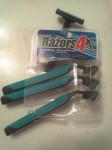
    But, this week, I saw this 4-pack of razors at the Dollar Store, and figured I’d save some money. Well, yesterday, I pulled one of them out, and prepared my stubble with my favorite shaving oil (which really does work better than any shaving cream I’ve ever tried), and started shaving.
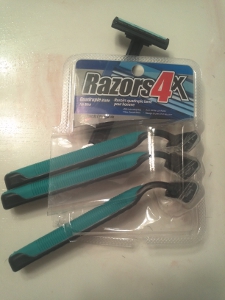
    From the Dollar Store (bad buy!)

    SCRRRRAAAAAAAATCCCCCCCCCCCCCHH!!!!!!!!!!!!

    Hmmm… that didn’t feel very good, and didn’t do a very good job of cutting whiskers. So, I tried going the opposite direction.

    S*C*R*R*R*R*A*I*A*I*A*I*A*I*T*C*C*C*C***O*U*C*H*!*!*!*!

    Not really believing it could really be that bad, I repeated the motions trying to vary the angle of contact. (Hmmm… I may have just confessed to being a slow learner.) It didn’t get any better, so I went back to the old razor that I had intended to toss, and finished shaving with that one.

    I still have a bit of razor-burn to show for yesterday’s efforts. But I’m cured of any urge to ever buy a Dollar Store razor again. Next trip to the grocery, I’m going to buy some good razors, and I’m not going to agonize over that particular de minimis cost again.

    I guess I should mention that I didn’t take the photo of those razors you see in this article with my T4i. I used my G2x Android smartphone, which works well enough for this sort of thing, and it’s what I had with me :)